10, May 2021
Southern Cameroons Crisis: Bishop George Nkuo’s anniversary Mass disrupted by gunfire 0
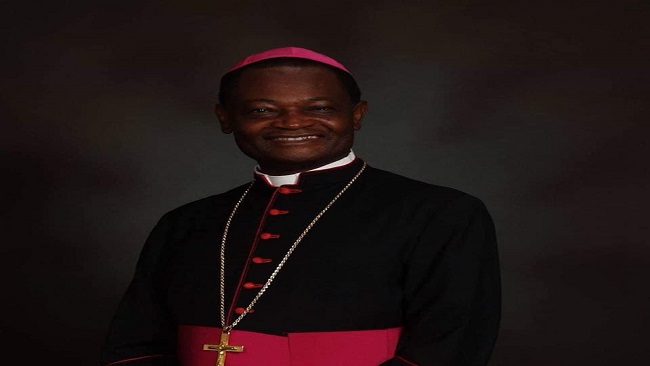
Sounds of gunfire interrupted an anniversary Mass for the bishop of Kumbo, in Cameroon’s troubled North West Region.
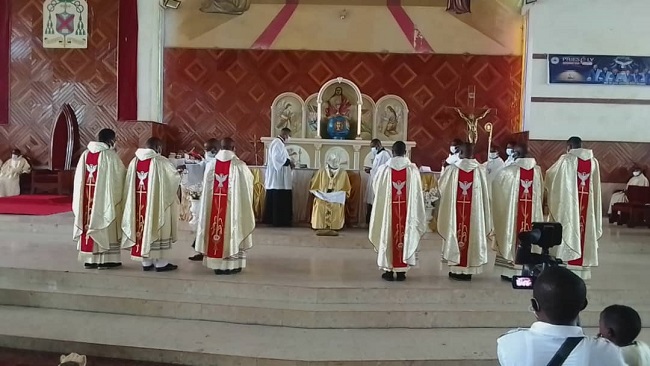
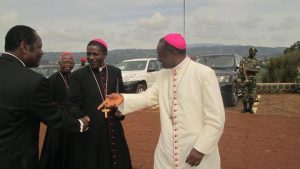
Bishop George Nkuo was marking the 40th anniversary of his priestly ordination on the premises of St. Augustine College Nso on May 7 when gunshots were heard, sending participants to the ground. There had been an exchange of fire between government troops and separatist rebels near the facility.
The North West Region and the South West Region are the English-speaking parts of Cameroon, and a separatist revolt against the majority French-speaking central government has been raging for nearly five years.
Among the people attending the event were Archbishop Andrew Nkea Fuanya of Bamenda and Adolphe Lele L’Afrique, the regional governor.
“The government is determined to bring long lasting peace in this division and in the whole region,” L’Afrique said afterwards.
“No stone will be left unturned to bring normalcy to Bui Division [the larger region surrounding the city] and to the city of Kumbo. The pacification effort of the administrative authorities, the operation to secure the division and the whole region will continue and will be stepped up to face the present situation,” he added.
Cecilia Vernyuy, a member of the Catholic Women’s Association, attended the anniversary Mass, and said the congregation was frightened by the gunfire.
“We all went lying on the ground,” she told Crux. “It was scary. It was as if the Church had come under attack.”
During his homily, Nkea said the exchange of gunfire so near the Mass showed the closeness Nkuo had with his people in Kumbo.
“The bishop is exercising his ministry especially as chief Shepherd of the Diocese of Kumbo in these difficult times,” the archbishop said.
“And we are witnesses to the fact that he is close to his sheep, he is standing near to his sheep and he is ready to die for his sheep, and this is a very big testimony to the Gospel message which he is preaching to the people and which is given out to the world,” he continued.
“The goodness of the shepherd is seen in his willingness and readiness to lay down his life for his sheep and this is a sign that the good shepherd’s first quality is to love his sheep … We have seen this love through our people and his readiness to lay down his life in his 40 years of service in priesthood.”
In his own remarks, Nkuo used the occasion to make the case for peace in his troubled region.
“Jesus Christ tells us that he is the Way, the Truth and the Light, and we need to be able to face the truth as it is, we need to be able to look at each other and say, ‘I am sorry’ and reconcile. Each of us must be able to look at his or her neighbor and say this is my brother, this is my sister,” the prelate said.
“My celebration in the heart of this reassures me that it is possible, if only we can break down the pride, and cultivate the love for truth and justice, and to care for one another.”
During a brief meeting about the security situation in Kumbo, Mayor Vernatius Mborong said the separatists have made life “very unbearable” for the people of the city.
“As I speak, there are six of my workers who were taken to the bush just four days ago. And you can bear with me that living under these kinds of circumstances is not easy. You cannot walk in town. You are moving somewhere, you look left, you look right. What kind of life is that? We are going through hell,” he said.
Vernyuy, the member of the CWA who attended the Mass, said all she needs is for peace to return to the community.
“All sides should put down the guns. All are dying on all sides, both military and separatists. They are all delivered by women,” she told Crux.
“We are crying for our land and we are also crying for our children. All of them are delivered by women. A woman can never abandon her child. All we pray for is that peace should return,” she added.
Political analyst Edwin Ebako says the government’s military-first approach to the Anglophone crisis is misguided, and lengthening the conflict.
“Before, the government knew that they were going to crack the separatists down using the military, but that method has not worked,” he told local news channel, Equinox TV.
“And every time the government has tried to use the wrong procedure that has only given the boys (separatists) room to evolve,” he added.
“When this issue began in 2016, the government would have known and would have quelled down this issue before it escalated. The crisis is only going to intensify if the government does not directly address the root causes of this problem and get into an all-inclusive dialogue to resolve the problem genuinely for the interest of the people of this nation,” Ebako said.
Source: Angelusnews
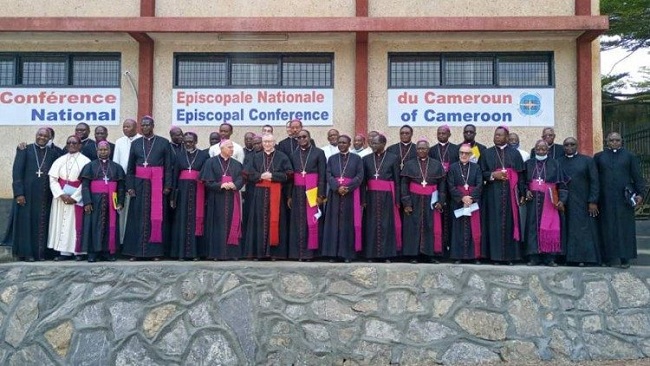
 The conflict had erupted in Cameroon’s Northwest and Southwest regions earlier in 2017 when protests against new government-appointed judges in the regions turned violent. As government forces responded with lethal force, tensions mounted and many English speakers in the predominantly French-speaking country started asking for independence. The ensuing conflict between separatist fighters and government forces has killed at least 3,000 civilians, according to Human Rights Watch. The Internal Displacement Monitoring Centre estimates that at least 460,000 have been forced to flee the affected areas, with tens of thousands seeking refuge in neighboring Nigeria. The Catholic bishops said the government has been too violent in its response to those seeking to form an English-speaking state. Esua said Biya’s 2017 pledge effectively made clear that “anybody who identified himself with the Anglophone cause was considered a terrorist.” After two years of fighting between the two sides, Biya called for a one-week “Major National Dialogue,” held Sept. 30-Oct. 4, 2019. However, the president said the dialogue would not only consider the insurgency but also “issues of national interest such as national unity, national integration and living together.” Bishop George Nkuo, who has headed the Kumbo Diocese in the Northwest Region since 2006, said that approach was wrong because it didn’t address the urgency of the Anglophone problem. Nkuo said the forum should have been used to discuss the Anglophone problem and not all the problems of the nation. He said it was necessary to use that dialogue to revisit the root causes of the conflict as the only possible way of bringing forth a sustainable solution. And the causes of the problem, he said, are rooted in Cameroon history. Initially colonized by Germany in 1884, Cameroon would be divided between Britain and France after the defeat of the Germans in World War I. Britain got one-fifth of the formerly German territory, which it administered as part of Nigeria until 1961 — when through a plebiscite, the British Southern Cameroons (as the British administered entity of Cameroon was then called) voted to reunite with the part formerly administered by France (which had gained its independence in 1960). The two entities went into a federal structure of government, with each entity allowed to freely run its affairs in line with the systems inherited from the colonial powers. But in recent years, some people in the English-speaking regions had accused the central government of trying to quash their traditions.
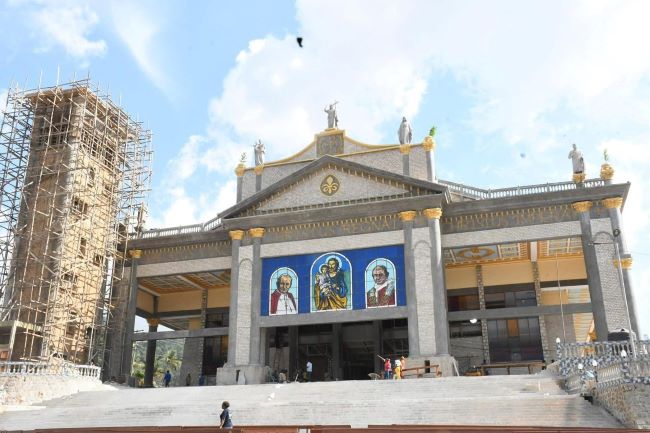
 A view of the Catholic cathedral of Kumbo, in Cameroon’s English-speaking Northwest Region In 2016, four Catholic bishops in the English-speaking regions accused Biya’s government of trying to strangle their culture. “Anglophone Cameroonians are slowly being asphyxiated as every element of their culture is systematically targeted and absorbed into the Francophone Cameroon culture and way of doing things,” they wrote at the time. Nkuo said the 2019 dialogue should have revisited these historical perspectives to come up with the right answers to the problem. The current archbishop of Bamenda, Andrew Nkea Fuanya, criticized the format of the dialogue, saying it didn’t involve the appropriate representatives of the English-speaking regions. “That wasn’t a dialogue at all,” Fuanya told NCR. Esua was invited to participate in the dialogue. “To be frank, it was a monologue,” he said. “In a dialogue, you take two people to dialogue. And in a dialogue, you have different opinions. You have to listen to the other person and the other person listens to you, and gradually you come to an agreement.” “Ninety percent of the participants at the National Dialogue were all government people, or people with government allegiance, but the real persons with whom you had to dialogue were not there,” said Esua. Separatist leaders weren’t part of the dialogue. Sesseku Ayuk Tabe, the recognized leader of the movement to form a new country of Ambazonia, was arrested in 2018 and is now serving a life sentence. “You couldn’t talk of a dialogue if these people weren’t there,” Esua said of the separatist leaders’ absence at the negotiating table. Nevertheless, the dialogue came up with a number of recommendations, including the adoption of a special status for the two Anglophone regions, the immediate relaunch of certain airport and seaport projects in the regions, the rapid integration of ex-combatants into society, and a hastening of decentralization of power away from the central government.










26, May 2021
Southern Cameroons Crisis: A priest gets kidnapped 0
A priest of the diocese of Mamfe in the Southwest region of Cameroon has been kidnapped as the fighting in Southern Cameroons rages on and enters a critical phase.
Father Christopher Eboka was taken away by unknown gunmen on Friday, May 21, 2021 who have requested a huge ransom from the diocese. The kidnapping of members of the clergy is unfortunate and this underscores the need for all the factions involved in the conflict to seek ways of reaching a peaceful resolution.
The Cameroon Concord News Group correspondent in Mbonge has spoken with Father Christopher’s mother who is very devastated and is urging those responsible for the priest’s kidnapping to release him so that he can continue with the great job he has been doing.
Kidnapping a priest is not only despicable, it is the height of irresponsibility and the Cameroon Concord News Group is joining its voice to that of the mother of father Christopher Eboka to urge the kidnappers to release the man of God.
Those who kidnap men of God are crossing a dangerous red line and this must be condemned by all god-fearing Cameroonians.
The clergy in the two English-speaking regions of the country has been playing a significant role since the Southern Cameroons crisis started in 2016 with the objective of engineering a lasting peace in the two English-speaking regions of the country and to help alleviate the suffering of the population.
Over the last two weeks, the fighting in Cameroon’s two English-speaking regions of the country had escalated, with army soldiers taking huge casualties.
Southern Cameroonian fighters who started out with dane guns have morphed into manufacturers of effective Improvised Explosive Devices (IEDs) which are sending many army soldiers to an early grave.
While the army soldiers have been brutal and successful in outgunning Southern Cameroonian fighters due to their superior weaponry, the use of IEDs by Southern Cameroonian fighters over the last year has left the government in an unfortunate quandary.
In the country’s northwest region where the fighting is escalating on a daily basis, the IEDs have been going off every day and many uniformed officers have not had the luck to return to their families.
The military has lost many of its fighting equipment and these new strategy developed by the Southern Cameroonian fighters has left many army soldiers with tones of butterflies in their stomachs.
The morale among the soldiers is down and many of them, especially those who have been to the battlefield, understand that this war will never be won on the battlefield, as Southern Cameroonian fighters have become deadlier and more determined to push the military out of Southern Cameroons.
Many of the young soldiers are from poor backgrounds and they need the salary from the military, but their belief in a conclusive military victory is diminishing on a daily basis as news of their wounded and dead colleagues spreads across the country like wildlife.
Many of those army soldiers would jump at any opportunity that would get them out of the military, but Cameroon is a country that is bereft of jobs and opportunities. The young soldiers are now caught between the rock and a hard place.
If they refuse to go to Southern Cameroons where Southern Cameroonian fighters are delivering death to many soldiers for free, they will end up in jail for a long time. If they head to Southern Cameroons, they are sure they will not be coming back to East Cameroon, or if they must return, it will either be in a body bag or with debilitating injuries that will make entirely dependent on their family members.
The situation in Southern Cameroons is dire. The world has to wake up from its sleep. The fighting in that part of the country has escalated and very many young Cameroonians are losing their lives because a government ruled by old and ailing leaders is still seeing negotiations as a weakness.
If the world does not stand up against the brutality playing out in Southern Cameroons now, it will one day regret its decision, as many young lives are being wasted due to the inflated ego of people who have prioritized war over peace.
By Soter Tarh Agbaw-Ebai